Your speaker bio is the single most important piece of text in your speaking career. It appears on every conference website, every CFP application, every event programme, your speaker portfolio, and in every organiser's inbox when you pitch. It is often the first — and sometimes the only — thing someone reads before deciding whether to book you.
A weak bio quietly costs you speaking gigs. A strong one books them. This guide shows you exactly how to write a speaker bio that gets you booked — with templates, real examples, and the three versions every working speaker should keep ready.
What Makes a Great Speaker Bio?
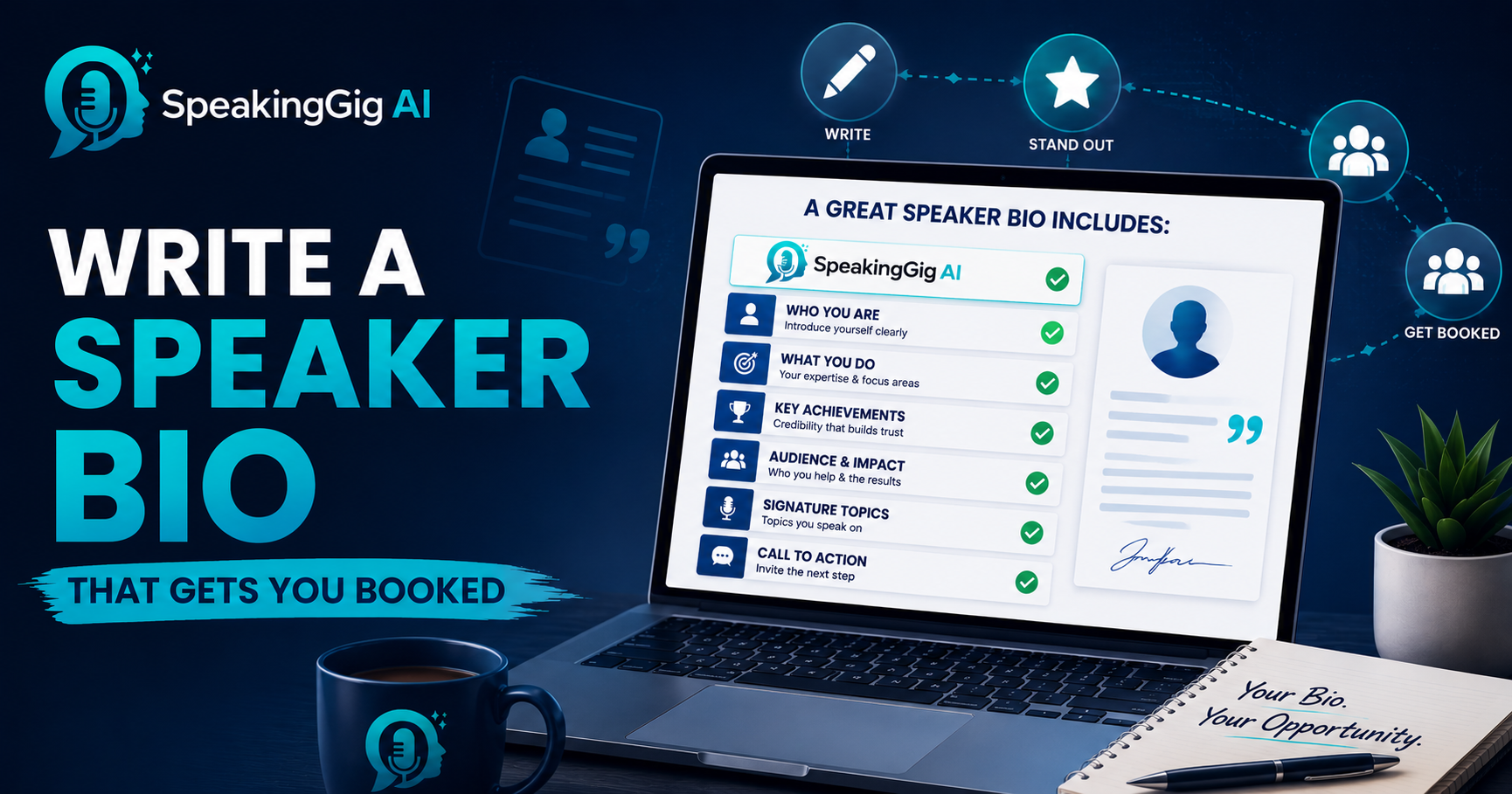
Great speaker bios aren't about you — they're about why an audience should listen to you. The best ones share five traits:
- Written in the third person. “Maya Chen helps…” reads as credible; “I help…” reads as a draft.
- Lead with authority. Open with the one line that makes you the obvious choice on your topic.
- Specific, not generic. “Helps SaaS teams cut churn” beats “is a passionate thought leader.”
- Framed around the audience outcome. Organisers book the value the room walks away with.
- Backed by proof and closed with a nudge. Named stages, results, and a clear way to book you.
The 3 Bio Lengths You Need Ready
Different stages ask for different lengths. Write all three once and you'll never scramble before a deadline again.
| Bio length | Word count | Where to use it |
|---|---|---|
| Short | 25–40 words | Conference programmes, speaker intros, social profiles |
| Standard | 75–120 words | CFP applications, event websites, your speaker portfolio |
| Extended | 200–300 words | Media kit, your About page, keynote announcements |
The Short Bio (25–40 words)
One punchy sentence or two. It has to land your authority and your topic fast.
Maya Chen helps data teams tell stories executives actually act on. A keynote speaker and former analytics lead, she turns dashboards into decisions for audiences at technology and finance conferences worldwide.
The Standard Bio (75–120 words)
Your workhorse bio — for CFP applications, event pages, and your portfolio. Authority, topics, proof, and a close.
Maya Chen is a keynote speaker who helps data teams turn analytics into decisions leaders trust. After a decade leading analytics at high-growth technology companies, she now speaks internationally on data storytelling, decision-making, and building a data culture. Her talks have helped teams at SaaS and finance conferences replace dashboard overwhelm with clear, confident action. Known for turning dense material into practical frameworks an audience can use on Monday morning, Maya makes data feel human — and useful. She is available for keynotes, workshops, and panels, and can be booked directly through her SpeakingGig profile.
The Extended Bio (200–300 words)
For your media kit, your About page, and keynote announcements — room to tell the fuller story without losing momentum.
Maya Chen is a keynote speaker and data-storytelling expert who helps organisations turn their analytics into decisions leaders actually trust. Over a decade leading analytics teams at high-growth technology companies, she watched brilliant insights die in dashboards no one acted on — and built a career out of fixing exactly that. Today she speaks internationally on data storytelling, decision-making under uncertainty, and building a data culture that scales. Maya's keynotes and workshops have reached audiences across technology, finance, and product conferences, where she is known for one thing above all: turning dense, technical material into clear frameworks an audience can put to work the next morning. She doesn't lecture at rooms; she changes how they think about their own numbers. Organisers describe her sessions as practical, energising, and refreshingly jargon-free. Beyond the stage, Maya mentors analytics leaders and writes on making data genuinely useful inside fast-moving teams. She is available for keynotes, workshops, and panels worldwide, in person and virtually, and can be booked directly through her SpeakingGig speaker portfolio.
Speaker Bio Template
Fill in the blanks, then tighten until every word earns its place:
[Name] is a [keynote speaker / expert] who helps [audience] [achieve outcome]. After [experience or credential], [he/she/they] now speaks on [1–3 topics]. [His/Her/Their] talks have [proof: stages, results, recognition]. Known for [signature strength], [Name] [what the audience gains]. [He/She/They] is available for [formats] and can be booked through [link].
Before and After: A Quick Rewrite
Before: “Maya is a passionate, dynamic thought leader with years of experience who loves inspiring audiences and is available to speak on a variety of topics.”
After: “Maya Chen helps data teams turn analytics into decisions leaders trust — a keynote speaker and former analytics lead who makes dense data practical for technology and finance audiences.”
The difference is specificity. The first could be anyone; the second could only be Maya — and tells an organiser exactly when to book her.
The Most Common Speaker Bio Mistakes
- Writing in the first person on a public bio — it reads unfinished.
- Burying the topic under job titles and company history.
- Vague adjectives (“passionate,” “dynamic,” “inspiring”) with nothing concrete behind them.
- No proof — no stages, results, or recognition an organiser can trust.
- No call to action — the reader is sold but doesn't know how to book you.
Real Speaker Bio Examples
Want to see strong bios in the wild? Browse real speaker portfolios on SpeakingGig — for example Will Lukang, John Miles, and Peter Ivanov — and notice how each leads with authority and a clear audience outcome. Browse more in our speaker directory.
Let AI Write Your Speaker Bio — and Put It to Work
Once your bio is sharp, it should be doing more than sitting in a document. On SpeakingGig, your bio powers your public speaker portfolio — indexed by Google and bookable directly — and feeds the AI that gives you speaking gigs matched to you, scoring every conference and CFP against your profile. A strong bio doesn't just read well; it helps you get booked. See how it works — it's free to start.
How to find speaking opportunities · Best CFP websites for speakers
Frequently Asked Questions
How long should a speaker bio be?
Keep three versions ready: a short bio (25–40 words) for programmes and intros, a standard bio (75–120 words) for applications and your portfolio, and an extended bio (200–300 words) for your media kit and About page.
Should a speaker bio be in first or third person?
Third person for any public-facing bio — it reads as credible and professional. Save first person for personal emails or direct messages.
What should a speaker bio include?
A clear authority line, your 1–3 topics, the outcome the audience gains, proof (stages, results, recognition), and a way to book you.
How do I write a speaker bio with no speaking experience yet?
Lead with your real expertise and the value you bring, cite adjacent proof (your work, writing, or smaller talks), and keep it specific. Confidence plus specificity beats a long résumé.
Can AI write my speaker bio?
Yes. SpeakingGig can help generate and refine your bio, then put it to work on your public portfolio and in AI-matched applications so it actively helps you get booked.
Your Next Speaking Gig Is Waiting
A great bio opens the door — SpeakingGig walks you through it. Create your free profile, publish a portfolio organisers can find, and let AI surface the speaking gigs matched to you.
Get started free
Ready to find your next speaking opportunity?
Matched Speaking Gigs for the right conferences and CFPs, application email drafts, and a speaker portfolio — all in one place.